
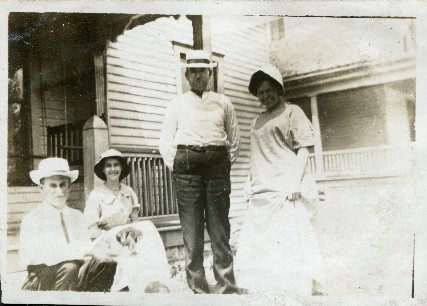
Somewhere in a family photo album, there may be a picture of someone whose name has long been forgotten. In a drawer, an old letter might hold the answer to a question no one thought to ask. And around a dinner table, a story passed from one generation to the next might be the only surviving connection to a moment in history.
These are the pieces of family history that make us who we are.
October is Family History Month, a time to celebrate the people, places, and experiences that shaped our families. It's an opportunity to ask questions, explore our roots, and preserve the stories that connect one generation to the next.
For the Eastland Disaster Historical Society, Family History Month speaks directly to the heart of our mission. Because the story of the Eastland Disaster is, in many ways, a collection of family histories.
On July 24, 1915, thousands of Western Electric employees, relatives, and friends gathered along the Chicago River, excited for a company picnic across Lake Michigan. It was supposed to be a day away from work, filled with music, dancing, food, and time together.
Instead, the SS Eastland rolled onto its side while still partially tied to the dock, claiming 844 lives.
The number is staggering. But what it cannot tell us is how many family stories changed that morning.
Behind those 844 lives were parents, children, brothers, sisters, husbands, wives, sweethearts, and friends. Some families lost several loved ones. Others lost the person who provided their primary source of income. Children grew up without parents. Parents faced futures without their children. Survivors returned home carrying memories that would remain with them for the rest of their lives.
And for generations afterward, families continued to feel the effects of that one morning.
Some descendants grew up hearing stories about a grandmother who survived or a great-uncle who never returned from the picnic. Others discovered their family's connection to the disaster only after finding an old newspaper clipping, examining a family tree, or asking a question about an unfamiliar name.
Still others may have no idea that their family history intersects with the Eastland at all.
That's what makes family history so fascinating. Sometimes the smallest discovery opens the door to an extraordinary story.
A name on a passenger list might lead to a census record that reveals an entire household. A cemetery marker might connect generations of relatives. A photograph tucked away for decades might finally put a face to someone known only through family stories.
And sometimes, the most meaningful discovery isn't a new fact. It's a better understanding of the person behind it.
What did they do for a living? Where did they grow up? Who were their friends? What were their hopes for the future? What was their life like before July 24, 1915?
These are the questions that turn historical records into human stories. They are also the questions that have guided the Eastland Disaster Historical Society since its founding in 1998.
Our work goes far beyond documenting the events of the disaster. We strive to create lasting legacies for the victims, survivors, rescuers, and everyone whose lives were touched by the tragedy.
Through our People Database, which now documents thousands of individuals connected to the Eastland, we bring together photographs, family relationships, historical records, personal accounts, and research that help tell a more complete story of each person.
And those stories continue to grow.
A descendant may contact us with a photograph that has been in the family for generations. Someone researching an ancestor may uncover a previously unknown connection. A letter, obituary, or newspaper article may reveal a detail that helps complete a person's profile.
What makes this work especially meaningful is that the discoveries often travel in both directions. Families share information that strengthens the historical record, and our research helps families discover pieces of their own history they never knew existed.
It's a remarkable partnership between the past and the present.
Family history also reminds us that preserving a story doesn't require a famous ancestor or a dramatic event. The everyday details matter just as much.
The neighborhood where someone lived. The factory where they worked. The church they attended. The people they loved. The traditions they carried from another country. The ordinary moments that made up their lives.
For many of those connected to the Eastland, these details are especially important. We know how their lives intersected with the disaster, but we also want to understand who they were before that day and how their families continued afterward.
Because no one's life should be defined solely by the circumstances of their death. This Family History Month, we invite you to become a family history detective.
Pull out those old photographs. Ask relatives about the people whose names you recognize but whose stories you don't know. Write down the memories that have been passed along. Take a closer look at the documents you've inherited.
And if your family has a connection to the Eastland Disaster, explore our People Database. You may discover information you didn't know, or you may have a photograph, document, or story that could help us learn something new.
Even if your family has no known connection to the Eastland, we hope you'll take the opportunity to preserve a little of your own history. Record a conversation with an older relative. Label the photographs in that forgotten box. Write down a favorite family story before the details begin to fade.
Someday, someone may be grateful you did.
More than 111 years after the Eastland Disaster, we continue to learn about the people whose lives were forever connected to that July morning. Each discovery adds another piece to the historical record, another connection between generations, and another reason to keep asking questions.
At the Eastland Disaster Historical Society, we believe every person has a story worth telling, and every family deserves the opportunity to know its history.
Because when we preserve a family story, we do more than remember the past. We give future generations something to hold onto.
Explore the Eastland Disaster Historical Society's People Database, learn about our family research services, or share your family's Eastland story at eastlanddisaster.org.